Scalp Micropigmentation (SMP)
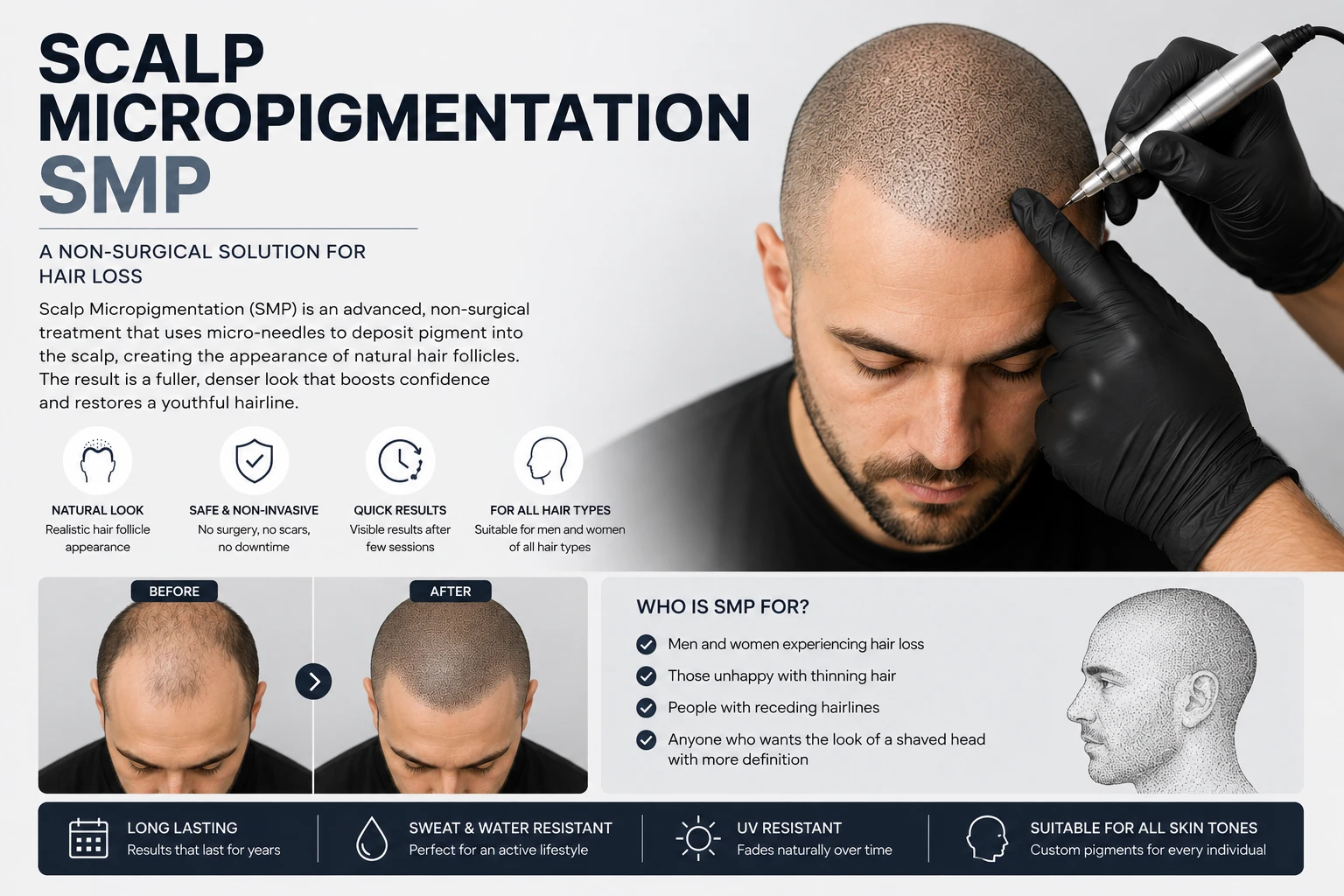
Scalp Micropigmentation (SMP) is a non-surgical, cosmetic medical procedure that creates the visual impression of fuller, denser hair by depositing thousands of tiny pigment dots into the upper dermal layer of your scalp. Unlike a hair transplant, SMP does not add new hair follicles — it mimics the appearance of a closely shaved scalp, increases visual density between existing hairs, conceals scars, or reconstructs a natural hairline.
At Now Hair Time, our scalp micropigmentation specialists use medical-grade plant-based pigments and ultra-fine micro-needles to deliver natural-looking, long-lasting results matched precisely to your skin tone and hair color.
How does Scalp Micropigmentation work?
SMP is typically performed across 2 or 3 sessions, scheduled 1 to 2 weeks apart. During each session, the practitioner uses a precision micro-needle to deposit pigment dots — each smaller than a real hair follicle — into the upper dermis (around 1.5 mm deep). The pigment is layered gradually so that final density and shade build up naturally.
- Session 1: A light base layer establishes the overall hairline shape and density.
- Session 2 (after ~10 days): Density is added; tone is refined; any uneven areas are corrected.
- Session 3 (optional): Final touch-ups, color matching, hairline polishing.
Each session lasts 3-5 hours depending on the area treated. Total cost includes all sessions and the follow-up touch-up at 6-12 months.
How SMP differs from a conventional tattoo
SMP is often described as "a scalp tattoo", but the two procedures differ in pigment, depth, instrument and technique. Those differences are the reason a general tattoo artist is not automatically qualified to perform SMP.
- Pigment: SMP uses pigments formulated to fade toward a neutral grey-black. Carbon-based tattoo inks can shift toward blue or green as they break down — an obvious giveaway on a scalp.
- Depth: Pigment is placed in the upper dermis. Tattoo ink is deposited deeper, where it is more likely to spread over the years and turn crisp dots into blurred patches.
- Instrument: Micro-needles far finer than tattoo needles produce dots sized and shaped to match a real follicle opening.
- Technique: SMP is pointillism, not line work. Dot size, angle, spacing and depth are varied deliberately so the pattern reads as natural stubble rather than a uniform stamp.
Who is Scalp Micropigmentation suitable for?
SMP is one of the most versatile non-surgical hair loss solutions. It works well for:
- Men with complete or partial baldness: Creates the appearance of a clean-shaven, buzzed haircut — ideal for those who already shave their head.
- Patients after a hair transplant: Adds visual density in areas between transplanted grafts, especially valuable for patients with limited donor area.
- Women with diffuse thinning: Reduces the contrast between scalp and hair, making thin areas appear fuller without surgery.
- Patients with scars: Camouflages FUE punch scars, linear FUT scars, or trauma/burn scars on the scalp.
- Receding hairlines: Reconstructs a natural, age-appropriate hairline without surgical intervention.
- Alopecia patients: Suitable for alopecia areata, totalis, universalis, and traction alopecia where transplant is not viable.
- Patients seeking a temporary or permanent alternative to transplant: SMP can be a standalone solution or a complementary treatment.
Who is not a good candidate for SMP?
An honest consultation rules people out as well as in. SMP should be postponed or reconsidered in the following situations:
- Active scalp problems: Infection, folliculitis, open wounds, sunburn, or a flare of psoriasis or eczema in the treatment area. Treat the skin first, then proceed.
- A tendency to form keloid scars: Raise this before booking so the practitioner can assess the risk and, where appropriate, test a small area.
- Recent hair transplant surgery: The scalp needs to finish healing and the new hair needs to grow before pigment placement can be planned accurately.
- Bleeding disorders, blood-thinning medication, uncontrolled diabetes or immunosuppression: Obtain clearance from your own doctor first.
- Known pigment or dye allergies: Ask for a patch test.
- Expecting SMP to behave like hair: Full-scalp SMP is designed to look like a closely shaved head. If you intend to grow your hair long, SMP will not deliver that — it adds the look of density, not length.
SMP vs Hair Transplant — Which is right for you?
| Scalp Micropigmentation (SMP) | Hair Transplant (FUE / DHI) | |
|---|---|---|
| Adds real hair? | No (visual illusion) | Yes (real follicles) |
| Surgery required? | No | Yes (minimally invasive) |
| Number of sessions | 2-3 | 1 (sometimes 2) |
| Recovery time | 3-7 days mild redness | 10-14 days visible recovery |
| Final result visible | Immediately after final session | 10-12 months (full growth) |
| Cost (Turkey) | From $1,500 | From $3,500 |
| Permanence | 4-8 years (touch-up required) | Permanent |
| Best for | Bald, scars, thinning, post-transplant density | Receding/thinning with viable donor area |
The two treatments are not rivals. Many patients get the best outcome by combining them: a transplant restores real hair where the donor area allows, and SMP fills the visual gaps between grafts so the result reads as denser than the graft count alone would allow.
Scalp Micropigmentation procedure at Now Hair Time
Your SMP journey at Now Hair Time follows a structured, patient-first process:
- Free online consultation: Send us photos of your scalp via WhatsApp or our website form. Our specialist will analyze hair loss pattern, existing density, scar tissue, and skin tone — then propose a personalized treatment plan and quote.
- Travel to Istanbul: All-inclusive packages cover airport transfers, 5-star hotel accommodation, translator service, and clinic transport.
- Pre-procedure consultation (in-clinic): Final hairline design, pigment matching, and treatment plan confirmation.
- Session 1 (3-5 hours): Topical anesthesia is applied. The practitioner deposits the base pigment layer.
- Recovery (3-7 days): Mild redness, no downtime. You can return home or stay in Istanbul.
- Session 2 (10-14 days later): Density and tone refinement.
- Session 3 (if needed): Final touch-ups.
- 12-month follow-up: Optional minor touch-up included in your package.
Recovery and aftercare
- Days 1-3: Scalp may appear darker than the final result; mild redness around treated areas. Avoid washing the scalp.
- Days 4-7: Begin gentle washing with lukewarm water (no soap). Pigment will appear sharper as the skin heals.
- Week 2: Healing complete. Pigment lightens by 20-30% — this is normal and intentional.
- Long term: Avoid prolonged sun exposure without SPF; the UV gradually fades pigment. Use sulfate-free shampoo.
The single biggest controllable factor in how long your result lasts is sun exposure. UV light breaks pigment down, so scalp SPF or a hat during long days outdoors is not a detail — it is the difference between a touch-up in four years and one in eight.
| Do | Avoid |
|---|---|
| Keep the scalp dry for the first 3 days | Washing, soap or shampoo on the treated area in the first 3 days |
| Wash gently with lukewarm water from day 4 | Scrubbing, exfoliating or picking at flakes |
| Protect the scalp with SPF or a hat outdoors | Sunbeds and long unprotected sun exposure |
| Moisturise once healing is complete | Sauna, steam room, swimming pool and heavy sweating for around 10-14 days |
| Use a sulfate-free shampoo long term | Harsh or alcohol-based scalp products |
How to choose an SMP practitioner
SMP is unregulated in many countries, and the gap between a good and a poor result is wider than in almost any other cosmetic procedure. Before you book, ask for the following:
- Healed results, not fresh ones: Any practitioner can photograph a scalp on the day of treatment. Ask to see the same patients at 12 months and beyond — that is when pigment colour, dot sharpness and hairline design are truly tested.
- SMP-specific pigments: Ask what pigment is used and whether it is formulated for scalp work rather than general body tattooing.
- Volume of SMP work: A practitioner who performs SMP regularly will read scalps and skin tones far better than one who offers it occasionally alongside other services.
- A hairline design that suits your age: A low, straight, sharply defined hairline looks artificial and ages badly. A natural design is slightly irregular and set at a height appropriate to your face and age.
- Hygiene you can see: Single-use needles opened in front of you and a properly sterile setup.
Treat pressure to pay a deposit immediately, prices far below the local market, and results shown only from the day of treatment as reasons to slow down and compare.
SMP cost in Turkey
Now Hair Time offers Scalp Micropigmentation at a fraction of US, UK, and European prices, without compromising on medical quality or pigment grade. Typical investment ranges:
- Partial coverage (hairline + crown): from $1,500
- Full scalp SMP (complete coverage for bald scalp): from $2,500
- Scar camouflage only: from $1,000
- Density add-on after hair transplant: from $1,800
All packages include 2-3 sessions, the 12-month touch-up, accommodation, transfers, and translator service. Compare to US prices ($4,000-$8,000) and UK prices (£3,500-£6,000) — Turkey delivers identical quality at 60-70% lower cost.
Frequently Asked Questions
Is Scalp Micropigmentation permanent?
SMP is considered semi-permanent. Pigment fades gradually over 4-8 years and a touch-up session restores the original look. Unlike traditional tattoos, SMP is designed to fade naturally so that as you age, the pigment continues to look proportionate to your remaining hair color.
Does SMP hurt?
Most patients describe SMP as mildly uncomfortable rather than painful. Topical anesthesia is applied before each session. Pain levels are typically lower than a traditional tattoo because the needle penetrates only the upper dermal layer.
Can SMP be combined with a hair transplant?
Yes. Combining SMP with FUE/DHI hair transplant is increasingly popular. SMP adds visual density in areas where graft survival is uncertain, masks the appearance of micro-scarring, and can be performed 6-12 months after transplant once the new hair has grown.
How long does each SMP session take?
Each session lasts 3-5 hours, depending on the treatment area. Full scalp SMP is the longest; hairline-only or scar camouflage takes around 2-3 hours per session.
Will the SMP look natural?
Yes — when performed by an experienced practitioner using medical-grade pigments matched precisely to your hair color and skin tone. Now Hair Time uses plant-based pigments specifically formulated to mimic the color shift of natural hair follicles. Up close and at a distance, properly executed SMP is indistinguishable from a freshly shaved scalp.
Can women have SMP?
Yes. Women with diffuse thinning, female-pattern hair loss (Ludwig stages I-III), or alopecia benefit from SMP because it reduces scalp visibility through the hair without requiring surgery or medication.
Is SMP suitable after a failed hair transplant?
SMP is one of the best non-surgical solutions for patients dissatisfied with prior transplant results. It camouflages scarring, adds density between sparse grafts, and corrects the appearance of a poorly designed hairline.
When can I go back to work after SMP?
Most people return to normal routine the next day. The treated area stays slightly red and looks darker than the final result for a few days, so some patients prefer to schedule sessions before a weekend.
Does SMP damage my existing hair?
No. Pigment is placed in the upper dermis between follicles, not into them, so it does not affect the growth of the hair you still have. SMP is regularly performed on thinning scalps precisely to make existing hair look denser.
Can SMP be removed if I change my mind?
Yes. Because pigment sits in the upper dermis, laser removal is generally more straightforward than for a conventional tattoo, though it still takes several sessions. SMP also fades on its own, so many people simply stop having touch-ups.
Does SMP work on every skin tone?
Yes. What matters is the contrast between pigment and skin, so the shade is mixed to suit your own skin tone and natural hair colour. On very light skin the pigment is diluted further; on darker skin a deeper shade is matched.
Get a free SMP consultation
Send your scalp photos via WhatsApp and receive a personalized SMP plan within 24 hours — including pigment match, session count, total cost, and recommended travel dates. Now Hair Time's medical coordinator will guide you through every step of the journey.