What Is Grey Hair Transplant?
If you are over thirty and noticing both hair loss and the first strands of grey, you may be asking a very practical question: can grey or white hair be transplanted at all? The short answer is yes. A hair follicle is a living structure, and its ability to be harvested and re-implanted does not depend on the colour of the hair it produces. Whether a strand grows out dark, salt-and-pepper, silver or fully white, the follicle beneath the skin works the same way. At Now Hair Time in Istanbul, Turkey, grey and white-haired patients are an everyday part of the work, and a hair transplant can be planned for them as carefully as for anyone else.
This guide explains what a grey (white) hair transplant involves, why hair turns grey, how techniques like FUE and DHI apply to depigmented hair, who makes a good candidate, and what realistic results look like.
Can Grey or White Hair Really Be Transplanted?
Yes. This is the single most important point to understand, because much of the anxiety around the topic comes from a simple misunderstanding. People sometimes assume grey hair is "weaker", "dead" or unsuitable for transplantation. None of that is true. The grey strand you see is simply hair that has grown without its usual pigment, and the follicle that produced it is still a viable, transplantable unit.
A hair transplant relocates healthy follicles from a donor area, typically the back and sides of the scalp, to areas where hair has thinned or stopped growing. The success of that relocation depends on follicle health, donor density and surgical technique, not on whether the hair is brown, black, blonde, grey or white. The relevant question is never "is my hair the wrong colour?" but "are my follicles healthy and is my donor area strong enough?"
Why People Believe Grey Hair Can't Be Transplanted
The myth usually comes from one real, practical challenge during surgery: visibility. When a hair shaft has lost its pigment, the tiny follicle can be harder to see clearly against the skin and surrounding tissue, so harvesting depigmented hair can be more technically demanding and may take a little longer. This is a workflow consideration, not a sign that the hair is unusable. Experienced teams manage it routinely with careful technique, good lighting and magnification, which is precisely why the skill of the medical team matters so much for grey-haired patients. When choosing a clinic, it is reasonable to ask whether the team regularly works with grey and white hair.
Why Does Hair Turn Grey or White?
Understanding why hair greys helps explain why transplanted grey hair behaves as it does. Each hair follicle contains pigment-producing cells called melanocytes, which generate melanin, the natural pigment that gives hair its colour. Over time, melanocyte activity tends to slow down. As pigment production decreases, hair grows in with less colour, eventually appearing grey and, with little or no pigment, white.
Several factors are commonly associated with greying:
- Age — the most common reason. Greying is a normal part of getting older, and it is why most hair transplant patients, who are frequently in their thirties, forties and beyond, already have some grey present.
- Genetics — the age at which you start greying tends to run in families. If your parents greyed early, you may too.
- Individual variation — some people grey in a concentrated, regional pattern, while others develop a more mixed "salt-and-pepper" distribution across the scalp.
Lifestyle and general health are often discussed in relation to greying as well, but the underlying mechanism in nearly all cases comes down to reduced pigment production within the follicle. Results and timelines vary from person to person.
Does Transplanted Grey Hair Stay Grey?
This is one of the most frequently asked questions, and the answer is reassuring in its simplicity. A transplanted follicle keeps the characteristics it had in the donor area. The hair colour, texture and growth pattern of a follicle are tied to that follicle itself. When it is moved to a new location, it carries those traits with it.
In practical terms:
- If you transplant follicles that currently produce grey or white hair, the relocated hair will continue to grow grey or white.
- A transplant does not "restore" colour to grey hair, and it cannot turn grey hair dark again. Pigment is determined biologically within the follicle, not by where it is placed.
- If your donor area is currently a mix of pigmented and grey strands, the transplanted region will reflect a similar blend, which helps the result look natural.
Greying is also an ongoing, natural process. Hair that is pigmented at the time of your procedure may grey later in life, just as it would have if it were never transplanted. This is normal and expected, not a complication of the surgery.
How FUE and DHI Apply to Grey and White Hair
The good news is that grey-haired patients have access to the same modern, minimally invasive techniques as everyone else. The two most widely used approaches are FUE and DHI.
FUE (Follicular Unit Extraction)
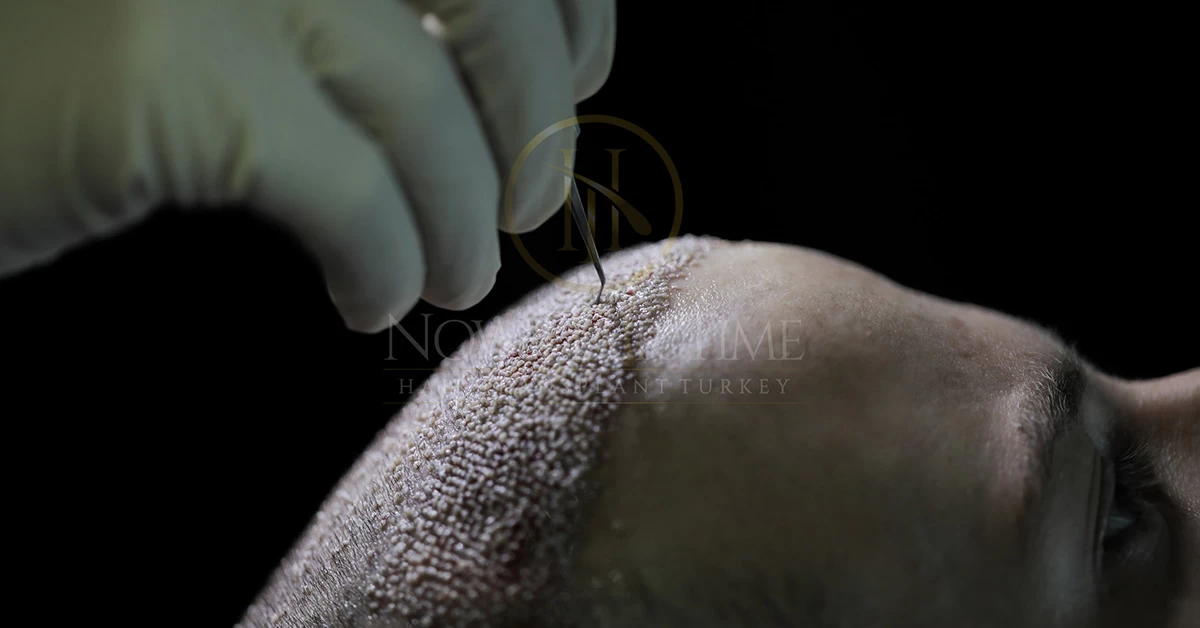
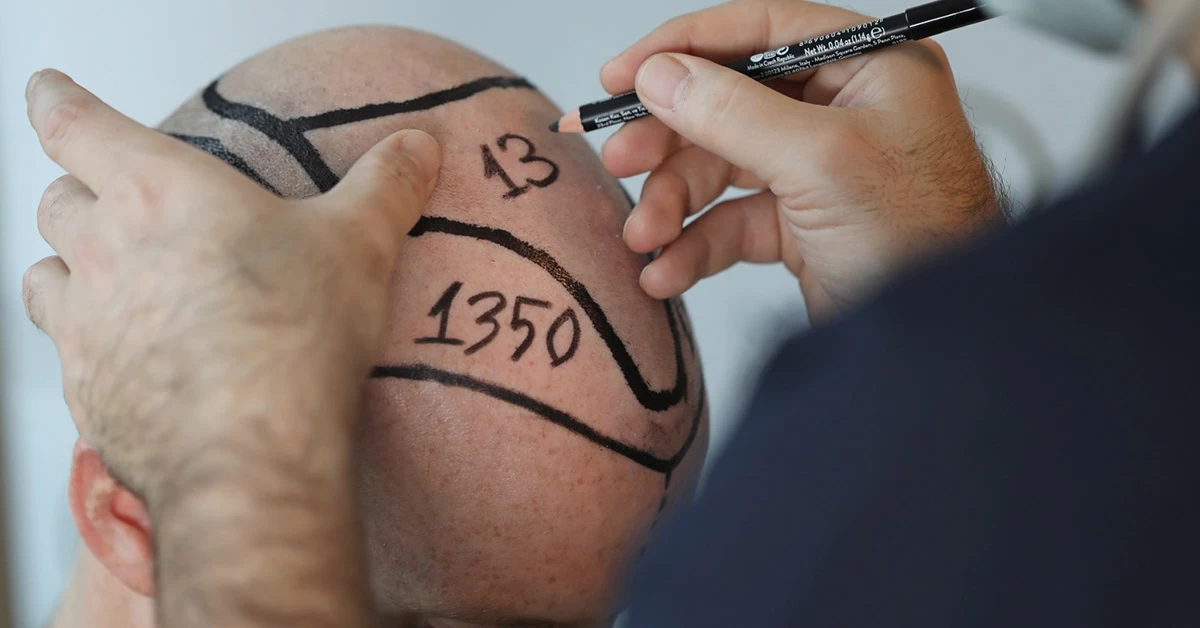
With FUE hair transplant, individual follicular units are harvested one by one from the donor area using a fine punch, then implanted into recipient sites. There are no linear strip incisions, and the technique is suitable for grey and white hair because, again, the follicle is harvested regardless of pigment. The main adaptation for depigmented hair is simply careful, well-lit extraction so that lighter follicles are clearly identified.
DHI (Direct Hair Implantation)
The DHI hair transplant method uses a specialised implanter pen that allows the follicle to be placed directly into the recipient area, giving precise control over the depth, angle and direction of each graft. This precision can be particularly useful when an exact, natural-looking placement is the priority. DHI is fully compatible with grey and white hair.
Which method suits you best depends on your donor characteristics, the size of the area being treated, and your goals. A qualified specialist will recommend the right approach after an in-person or detailed remote assessment.
Candidacy and Donor Assessment
Having grey hair does not, by itself, make you a better or worse candidate. The factors that determine candidacy are the same as for any hair transplant:
- Donor supply — the density and quality of follicles at the back and sides of the scalp. A strong donor area gives the surgeon more to work with.
- Pattern and extent of hair loss — the size of the area to be covered relative to the available donor hair.
- Hair characteristics — calibre, curl and density all influence how much coverage a given number of grafts can achieve.
- General health — any conditions that may affect healing are reviewed during consultation.
- Realistic goals — a clear, achievable plan agreed between you and your specialist.
A thorough assessment looks at donor density, the size of the recipient area, and the total number of grafts likely to be needed. From there, the team plans the angle, direction and spacing of placement and, crucially, designs a natural front hairline. Suitability can only be confirmed by a specialist who examines your scalp directly, and results vary between individuals.
An Underrated Advantage: Grey Hair Can Help the Result Look Natural
Here is a point many people do not expect: grey and white hair can actually be forgiving in a way that works in the patient's favour. Because lighter hair offers less contrast against the scalp, it can help soften the visual difference between transplanted and existing areas, making subtle density variations less obvious.
Where very dark hair against pale skin creates strong contrast that draws attention to every detail of the hairline, grey and silver hair tends to blend more gently. For the right patient, this can contribute to a soft, natural and age-appropriate appearance, though individual results vary.
What to Expect on the Day and During Recovery
A hair transplant is typically a single-day outpatient procedure lasting several hours, and as noted, procedures on white or grey hair can run somewhat longer because of the extra care needed during harvesting. You are awake and comfortable throughout, with local anaesthesia used to numb the treatment areas.
General Aftercare Principles
Aftercare for grey-haired patients is the same as for any modern transplant. Your clinic will give you personalised instructions, but common guidance includes:
- Protect the grafts in the first days — avoid rubbing, scratching or knocking the recipient area.
- Sleep with your head slightly elevated for the first nights to help manage swelling.
- Follow the recommended washing routine exactly, starting only when your clinic advises.
- Avoid strenuous exercise, swimming, saunas and direct sun for the period your specialist recommends.
- Be patient with shedding — transplanted hairs often shed in the early weeks before new growth begins. This is an expected phase, not a failure.
- Attend follow-ups and contact your clinic with any concerns.
New growth appears gradually over the following months, with the fuller picture developing over roughly a year. Patience is essential, and timelines differ from person to person.
Realistic Expectations
A grey hair transplant can be an effective way to address thinning, but it is important to keep expectations grounded. A transplant redistributes your existing follicles; it does not create new hair from nothing, and it cannot guarantee a specific outcome. It will not change the colour of your hair, and it does not stop the natural process of greying or any ongoing hair loss elsewhere on the scalp.
The best outcomes come from a careful plan, an experienced team, a realistic understanding of what surgery can and cannot do, and good aftercare. Always consult a qualified specialist who can assess your individual situation.
Frequently Asked Questions
Can grey or white hair be transplanted?
Yes. The follicle is viable and transplantable regardless of the colour of the hair it produces. Grey and white hair are routinely treated using the same techniques as pigmented hair.
Will my transplanted grey hair turn dark again?
No. A transplant relocates follicles but does not change their colour. Grey or white follicles will continue to grow grey or white hair, because pigment is determined within the follicle itself.
Is a grey hair transplant more difficult than a normal one?
The principles are identical, but white and grey follicles can be harder to see during surgery, so the procedure may demand more care and take a little longer. This is why an experienced team is especially valuable.
Can I use FUE or DHI for grey hair?
Both FUE and DHI are fully suitable for grey and white hair. The right technique for you depends on your donor area, the extent of hair loss and your goals, which a specialist will assess.
Does having grey hair make the result look more natural?
It often can. Because grey and white hair has lower contrast against the scalp, it can help mask small density differences and blend transplanted and existing hair more softly. As with all results, this varies between individuals.
How do I know if I'm a good candidate?
Candidacy depends on donor supply, the pattern and extent of hair loss, hair characteristics, general health and realistic goals — not on hair colour. Only a qualified specialist can confirm suitability after examining your scalp.
If you have started to grey and are considering restoring your hairline or adding density, you do not have to let hair colour hold you back. Now Hair Time in Istanbul, Turkey works with grey and white-haired patients as a routine part of its practice, combining experienced surgical teams with modern FUE and DHI techniques. To find out whether a grey hair transplant is right for you, reach out for a personalised assessment with a qualified specialist and explore your options for a hair transplant in Turkey.