Body Hair Transplant (BHT): Using Beard & Body Hair as a Donor
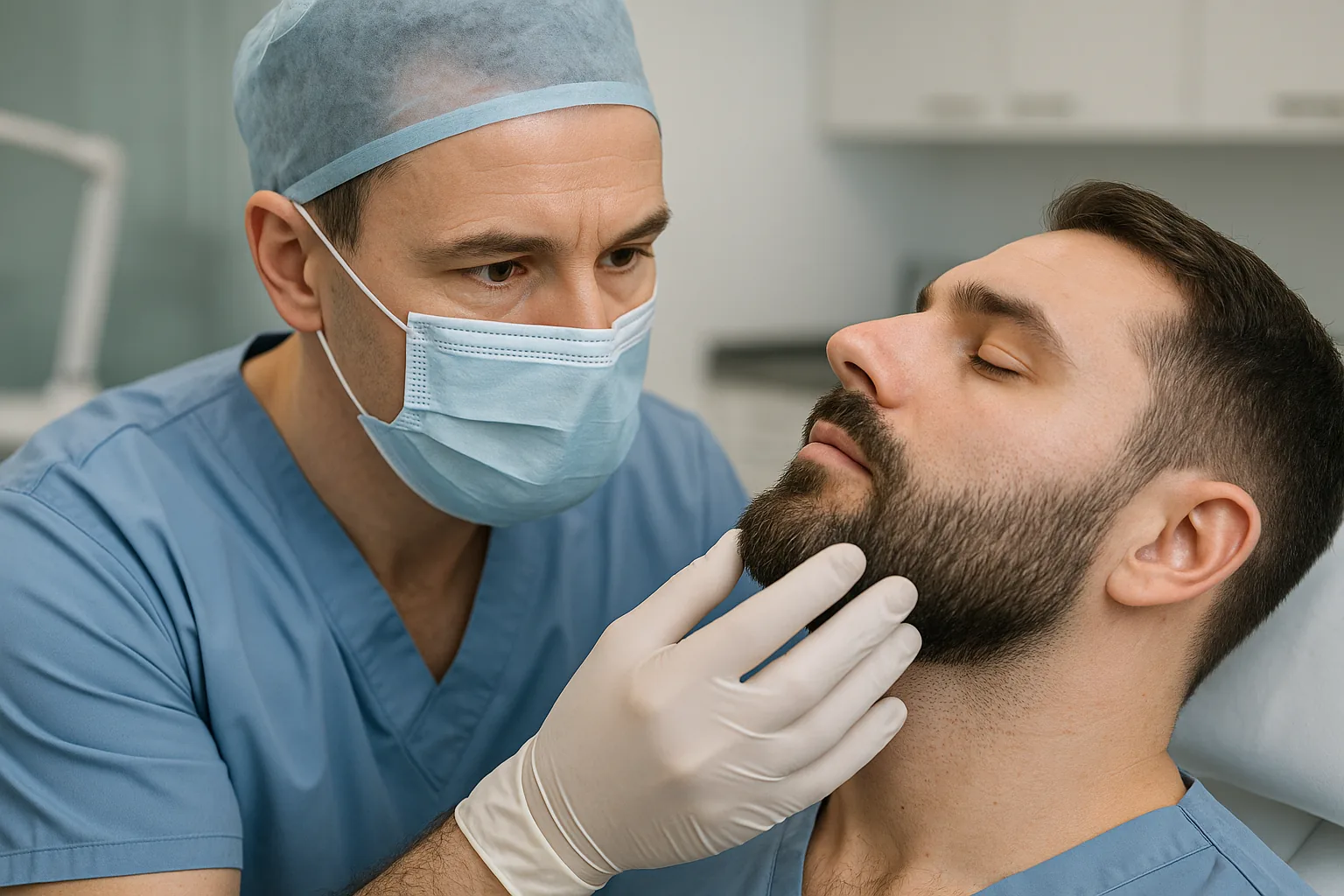
Every hair transplant depends on a finite resource: the donor area. The permanent zone at the back and sides of the scalp only contains so many follicles, and in patients with advanced loss or a previously over-harvested donor, the scalp alone may not supply enough grafts to meet the goal. Body hair transplant (BHT) addresses this limitation by harvesting healthy follicles from beard and body areas to supplement — and in some cases substantially extend — what the scalp can provide.
At Now Hair Time in Istanbul, BHT is used as a carefully planned extension of conventional scalp surgery, most often to add coverage and density when the scalp donor is depleted, weak, or simply not large enough for the area that needs to be restored. This guide explains how the technique works, which donor areas are worth using, how body hair behaves differently from scalp hair, and what realistic results look like.
What is a body hair transplant (BHT)?
A body hair transplant is an FUE procedure in which individual follicles are harvested from non-scalp areas — most commonly the beard, then the chest, and occasionally other body regions — and implanted into the scalp. It uses the same micro-punch extraction and recipient-site technique as scalp FUE, but draws from a different donor supply to overcome the natural limits of the head.
In a standard FUE hair transplant, follicular units are removed one by one from the back and sides of the scalp using a small rotary or manual punch, then placed into tiny incisions in the thinning or bald recipient area. BHT applies that exact philosophy to the face and body. Instead of being limited to the roughly two horseshoe-shaped strips of permanent scalp hair, the surgeon can tap into the thousands of follicles that exist in the beard and across the torso.
It is important to frame BHT correctly: it is not an alternative to scalp surgery for most patients, and it is not a shortcut to unlimited grafts. It is a supplementary donor strategy. The scalp remains the foundation, and body hair is added on top of it to reach numbers and density that the scalp could not deliver on its own. Because of the biological differences between body hair and scalp hair, BHT requires more surgical experience, more careful planning, and more honest expectation-setting than a routine scalp case.
Why is the scalp the first-choice donor, and what are its limits?
The scalp's permanent zone is the gold-standard donor because the follicles there are genetically resistant to the hormone (DHT) that causes male pattern baldness. They are also a close match to the recipient area in texture, growth rate, and length potential, which makes them blend seamlessly and grow like normal head hair. For these reasons, the scalp is always harvested first.
The limitation is supply. The safe donor area contains a finite number of follicular units, and only a portion of them can be removed without thinning the donor visibly. Over-harvesting leaves the back and sides looking patchy or moth-eaten, which is a permanent and difficult problem to correct. Every responsible surgeon therefore treats the scalp donor as a budget that must last a lifetime, especially in younger patients whose loss is likely to progress.
When the area that needs restoring is very large — an advanced Norwood pattern, for example — or when the donor has already been depleted by previous surgeries, the math simply does not work with scalp hair alone. This is the precise scenario where BHT becomes valuable. If you are unsure how many grafts your case requires, our guide on how many grafts you need for a hair transplant explains how surgeons estimate the figure, and a free consultation can give you a personalised assessment.
Which donor areas can be used, and in what order of preference?
The most useful non-scalp donor is the beard, particularly the area under the chin and along the jawline and neck, because it offers high follicle density and good survival. After the beard, the chest is the next most common source. Other body areas — back, abdomen, shoulders, arms, and legs — can be used in select cases but generally rank lower in quality, yield, and predictability.
The order of preference is driven by how closely each area's hair resembles scalp hair and how reliably it survives transplantation. Beard hair sits at the top because it is thick and grows in a relatively long cycle. Chest hair is a reasonable second. The remaining body areas are typically reserved for patients who need very large graft numbers and have limited alternatives, and they are used to add background density rather than to create visible detail.
| Donor area | Preference | Typical characteristics | Best used for |
|---|---|---|---|
| Beard (under-chin, jawline, neck) | First choice body donor | Thick calibre, high density, generally strong survival, longer growth cycle than other body hair | Density behind the hairline, mid-scalp and crown; blending with scalp grafts |
| Chest | Second choice | Moderate calibre, often curly, shorter length potential | Background density in the crown and mid-scalp |
| Back, shoulders, abdomen | Select cases | Variable calibre and density, less predictable yield | Bulk coverage in large-area restorations |
| Arms and legs | Rarely used | Fine, short growth cycle, lower survival | Occasional supplementary grafts only |
Not every patient has usable body hair. A man with a full, dense beard has a meaningful secondary reservoir; a man with a sparse beard and little body hair does not. Donor planning always begins with a physical assessment of what is actually available across the scalp, face, and body.
Why is beard hair the best body donor?
Beard hair is the strongest non-scalp donor because its follicles are thick, plentiful, and tend to survive transplantation well. A single beard graft is often a robust single-hair follicle with a wide shaft, so it adds noticeable visual weight. This makes beard hair excellent for building density behind the hairline, through the mid-scalp, and in the crown — though not for the delicate front edge.
The calibre advantage matters because perceived fullness depends heavily on the thickness of each hair, not just the number of follicles. Coarse beard hairs cover more visual scalp per graft than fine hairs, so they can make a real difference in how dense a result looks. For patients whose scalp donor is fine or limited, beard grafts can be the element that pushes a result from "thin but improved" to genuinely full-looking through the back half of the scalp.
The crucial caveat is placement. Beard hair is generally too thick, and sometimes too wiry or differently angled, to use along the immediate frontal hairline, where single fine hairs are needed to create a soft, natural transition. A skilled surgeon reserves the finest scalp grafts for the hairline and deploys beard grafts behind it, where their bulk is an asset rather than a liability. Used this way, beard hair complements scalp hair beautifully. If you are considering harvesting from the beard, it is also worth understanding the reverse procedure in our guide to beard transplant in Turkey.
How does body hair differ from scalp hair?
Body and beard hair differ from scalp hair in three ways that directly affect results: texture, growth cycle, and curl. Body hair tends to be coarser or curlier, and it has a shorter active growth (anagen) phase, which means it does not grow as long as scalp hair. These differences influence where each follicle should be placed and what the patient should realistically expect.
The single most important difference is the length of the growth cycle. Scalp hair stays in its active growing phase for years, which is why head hair can grow very long. Body hair has a much shorter anagen phase, so each hair reaches a maximum length and then sheds. Transplanted body hair largely retains this behaviour, which means it will generally not grow to the same length as surrounding scalp hair and is therefore best suited to areas worn at moderate length rather than long styles.
Texture and curl also matter. Many body hairs are curlier and have a different cross-sectional shape than scalp hair, which can make blending less predictable until the hairs are interspersed among scalp grafts. After transplantation, body hair adapts only partially to its new home — it may take on slightly faster growth than it had on the body, but it does not fully convert into scalp hair. Honest planning accounts for this rather than promising that body grafts will become indistinguishable from native head hair.
| Characteristic | Scalp hair | Body / beard hair |
|---|---|---|
| Growth cycle (anagen length) | Long — hairs grow for years | Short — hairs reach a set length, then shed |
| Maximum length potential | High; suits long styles | Limited; suits short-to-moderate styles |
| Texture and shaft | Often finer, straighter on the shaft | Often coarser (beard) or curlier (chest) |
| Curl / root angle | More uniform, easier to angle | More curl and variable angle, harder to control |
| Survival when transplanted | High and predictable | Good for beard; more variable for other body areas |
| Best recipient zone | Anywhere, including the hairline | Behind the hairline — density, mid-scalp, crown |
When is BHT recommended?
BHT is recommended when the scalp donor cannot supply enough grafts on its own: advanced baldness over a large area, a depleted or weak scalp donor from age or previous over-harvesting, and repair or corrective cases. It is a supplementary strategy for difficult, high-demand situations — not a first-line option for routine, early-stage hair loss.
The clearest indication is advanced pattern loss where the bald area is simply larger than the available scalp donor can cover at an acceptable density. In these cases, adding beard and chest grafts can meaningfully increase total coverage and fullness that scalp hair alone could never reach. A second common indication is a donor that has already been heavily harvested in prior surgeries, leaving too few scalp follicles for a touch-up or a further stage.
Repair work is a third scenario. Patients who have had poor previous transplants sometimes need extra grafts to camouflage scarring, correct pluggy grafts, or rebuild areas without further taxing an already weak scalp donor. In all of these situations, the deciding factors are donor supply, the size of the area to be covered, and the quality of the patient's beard and body hair — which is why an in-person or photo-based assessment is essential before BHT is ever recommended.
Why is BHT almost always combined with scalp grafts rather than used alone?
BHT is almost always combined with scalp hair because the two donor sources complement each other: fine scalp grafts build a natural hairline and the visible detail, while beard and body grafts add density and bulk behind it. Body hair used in isolation rarely produces a natural, full result, so it is used to extend the scalp donor, not to replace it.
The reasoning comes back to placement and behaviour. The frontal hairline is the most scrutinised part of any result, and it demands fine, single hairs placed at precise angles to look soft and undetectable — exactly what scalp hair provides and exactly what coarse beard hair does not. If a hairline were built from beard hair alone, it would tend to look too thick, too uniform, or unnatural at the very edge where subtlety matters most.
At the same time, the crown and mid-scalp benefit enormously from the visual weight of beard grafts. By combining the two — scalp grafts at the front and along the part, body and beard grafts filling in behind — the surgeon gets the best of both: a natural-looking hairline and a denser, fuller overall appearance. This combined approach is the standard way BHT is used in well-run clinics, and it is the model followed for hair transplant in Istanbul patients at Now Hair Time.
What does the procedure and harvesting involve?
BHT harvesting uses FUE punches adapted to body hair, often slightly different in size and technique because body follicles sit at different angles and depths than scalp follicles. Extraction from the beard and body is more time-consuming per graft, so BHT sessions can take longer, and the procedure is performed under local anaesthesia just like scalp FUE.
Before surgery, the donor areas are trimmed and mapped. The surgeon assesses follicle angle, depth, and density at each site, because these vary considerably across the beard, chest, and other regions. During extraction, the punch must follow the curve of each follicle to avoid transection (cutting the root), which is technically demanding given that many body hairs are curly beneath the skin. Beard extraction in particular requires care to keep the harvest evenly distributed so the donor area stays natural.
Once harvested, body and beard grafts are handled and implanted with the same micro-incision technique as scalp grafts, with the surgeon planning angle and direction so the transplanted hair lies in a natural pattern. Because harvesting is slower and more meticulous, large BHT cases may be staged across more than one session. The recipient-side procedure — site creation and graft placement — is essentially the same as in conventional FUE, which is why combining scalp and body grafts in a single plan is feasible.
Who is not a good candidate for BHT?
Poor candidates for BHT include men with sparse beard and body hair (too little secondary donor to make a difference), those seeking only a frontal hairline (where fine scalp hair is required), and anyone expecting body grafts to grow long like scalp hair. Patients with unrealistic expectations or unstable, very early loss are also generally not suitable.
The first practical disqualifier is simply a lack of usable body hair. BHT only helps if there is a meaningful reservoir of beard or body follicles to harvest; a man with a thin beard and little chest hair gains little from the technique. The quality of that hair matters too — coarse, healthy beard hair is far more useful than fine, sparse body hair.
Expectation is the other major factor. A patient who wants the convenience of long, flowing hair grown from body grafts will be disappointed, because body hair's short growth cycle limits its length. Likewise, someone whose only concern is a precise, natural hairline does not need BHT at all — that is a job for fine scalp grafts. A thorough consultation screens for these mismatches, and a reputable surgeon will decline to perform BHT when it is unlikely to serve the patient well.
What results and timeline can you realistically expect?
Transplanted body and beard hair sheds within the first few weeks, then regrows over the following months, with fuller results visible by roughly 9–12 months as with scalp FUE. Realistically, BHT adds density and coverage rather than perfection: beard grafts can noticeably improve fullness behind the hairline, but body hair will not match scalp hair in length or, sometimes, in exact texture.
The timeline mirrors a standard transplant. After the procedure, the implanted follicles enter a resting phase and the visible hairs fall out — this is expected and not a sign of failure. New growth begins to emerge over the following months, thickens progressively, and approaches its final appearance toward the end of the first year, sometimes with continued refinement a little beyond that.
What sets honest expectations apart is acknowledging the role BHT plays. Used correctly, it is a powerful way to extend a limited donor and lift overall density, and in skilled hands the blended result can look natural and full. But it is an enhancement layered onto good scalp work, not a miracle that turns body hair into a flawless head of hair. The best outcomes come from realistic goals, a strong surgical plan, and an experienced team — all of which begin with a candid consultation.
What is recovery in the donor areas like — does taking beard hair leave marks?
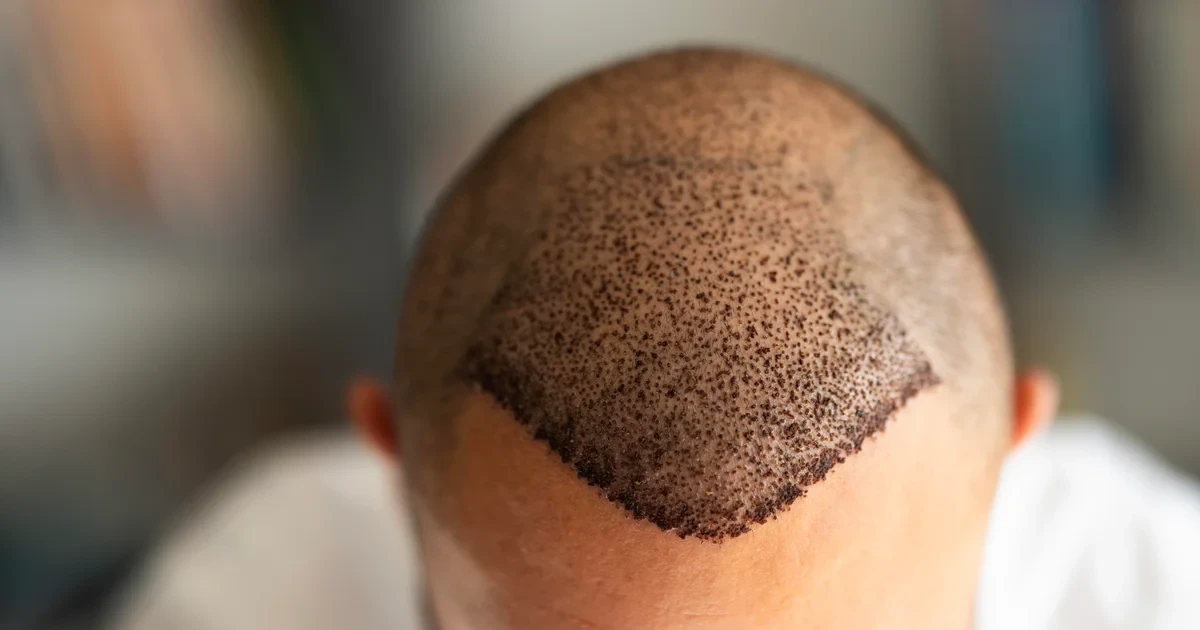
FUE harvesting from the beard and body leaves tiny dot-like openings that typically heal into small, faint marks, scattered so that they are usually inconspicuous once healed and hair regrows around them. Donor recovery is generally short, with redness and minor scabbing in the harvested areas settling over the first one to two weeks.
Because FUE removes follicles individually rather than in a strip, it does not leave a linear scar. Instead, each extraction point is a pinpoint that fades over time. In the beard, the surrounding stubble and hair help conceal these points, and when harvesting is spread evenly, the donor area does not look obviously thinned. The same applies to the chest and other body sites, where remaining hair camouflages the harvested zone.
As with any procedure, healing varies between individuals and depends on skin type and how the harvest is performed. Following the clinic's aftercare instructions — keeping the areas clean, avoiding trauma, and protecting healing skin — helps the donor sites recover smoothly. Most patients find that beard and body donor areas are comfortable and discreet within a couple of weeks, with the small marks continuing to fade thereafter.
What factors affect the cost of BHT?
The cost of a body hair transplant depends mainly on the number of grafts required, how many donor areas are harvested, the complexity and length of the procedure, and whether it is staged across more than one session. Because BHT harvesting is slower and more technically demanding than scalp FUE, it generally involves more surgical time than a comparable scalp-only case.
Graft count is the primary driver, just as it is in conventional surgery: a large restoration that needs thousands of combined scalp and body grafts requires more time and resources than a small supplementary procedure. Harvesting from multiple areas — beard plus chest, for instance — adds complexity, as does any repair or corrective element. The experience of the surgical team and the standard of the facility also factor in, since BHT rewards expertise.
Rather than quoting a single figure, the responsible approach is a personalised quotation after assessing your donor areas, the size of the region to be treated, and your goals. We do not publish fixed prices for BHT here, because an accurate estimate depends entirely on your individual case. The most reliable way to understand your options and cost is to request a free, no-obligation consultation with the Now Hair Time team in Istanbul.
Frequently asked questions
Can body hair really be used for a hair transplant?
Yes. Healthy follicles from the beard and body can be harvested with the same FUE method used on the scalp and implanted into the head. Beard hair is the most useful body donor, and body hair is generally added to scalp grafts to extend a limited donor area rather than used entirely on its own.
Is beard hair good for a hair transplant?
Beard hair is the best non-scalp donor because it is thick, plentiful, and tends to survive well. Its calibre adds visual density, which makes it excellent for the area behind the hairline, the mid-scalp, and the crown. It is generally too coarse for the immediate frontal hairline, where fine scalp hairs are preferred.
Will transplanted body hair grow as long as my scalp hair?
Usually not. Body and beard hair have a shorter active growth phase than scalp hair, so each hair reaches a maximum length and sheds rather than growing very long. Transplanted body hair largely keeps this behaviour, which is why it suits shorter-to-moderate styles and is placed where length is less critical.
Does harvesting beard hair leave a scar or thin out my beard?
FUE harvesting leaves tiny dot-like marks rather than a line, and when the harvest is spread evenly the beard does not look obviously thinned. Surrounding stubble helps conceal the extraction points, which fade over time. Most beard donor areas heal discreetly within a couple of weeks.
Can a hair transplant be done with body hair alone?
It rarely produces a natural, full result on its own. The hairline needs fine scalp hairs for a soft, undetectable edge, which coarse body hair cannot reliably provide. BHT is almost always combined with scalp grafts — scalp hair at the front, body and beard hair for density behind it.
Who is a good candidate for BHT?
Good candidates have advanced hair loss or a depleted scalp donor, plus a meaningful reservoir of beard or body hair to harvest. It also suits some repair cases. Men with sparse body hair, those wanting only a hairline, or anyone expecting body grafts to grow long are generally not ideal candidates.
Is a body hair transplant safe?
When performed by an experienced team, BHT uses the same well-established FUE principles as scalp surgery under local anaesthesia. The main considerations are the technical difficulty of harvesting curved body follicles and the need for realistic expectations. A thorough consultation and a skilled surgeon are key to a safe, satisfying outcome.
How long does it take to see results from BHT?
The transplanted hairs shed within the first few weeks, regrow over the following months, and approach their fuller appearance around 9 to 12 months, much like scalp FUE. Larger cases may be staged across more than one session, and final refinement can continue a little beyond the first year.
How much does a body hair transplant cost?
Cost depends on the number of grafts, how many donor areas are used, the complexity of the procedure, and whether it is staged. Because harvesting body hair is slower and more demanding, BHT often involves more surgical time than scalp-only surgery. An accurate price requires a personalised assessment, so we recommend a free consultation.
Will body hair grafts blend with my scalp hair?
When planned well, yes — interspersing body and beard grafts among scalp hair helps them blend, and body hair adapts partially to the scalp after transplantation. However, it does not fully convert into scalp hair, so some difference in texture or curl can remain. Skilled placement minimises any mismatch.