Robotic Hair Transplant (ARTAS & NeoGraft): How It Works vs Manual FUE
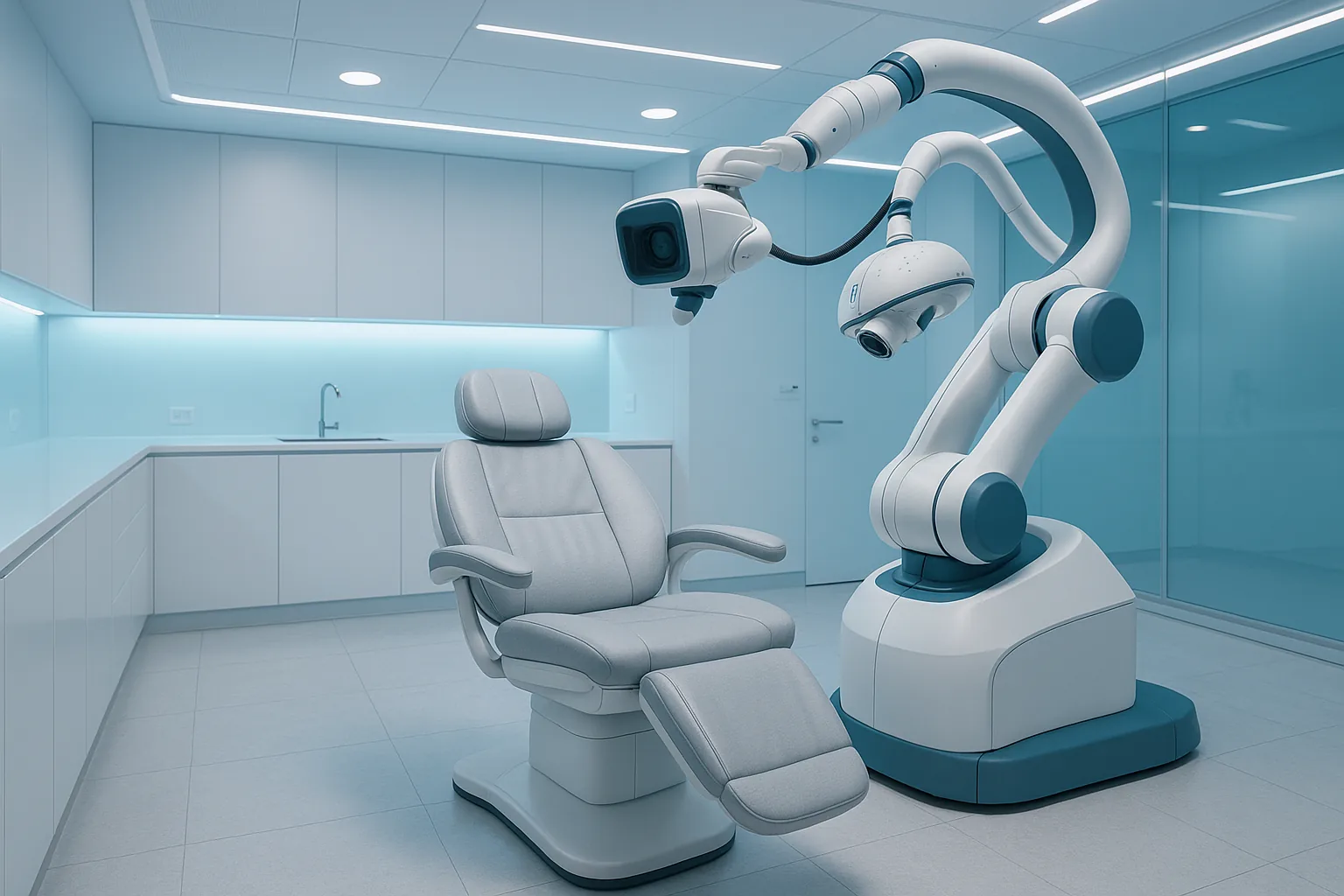
A robotic hair transplant is a semi-automated form of FUE in which a computer-guided system helps a surgical team extract (and sometimes implant) follicular units more consistently. It is assistance, not autonomous surgery: the device does not design your hairline or decide where each graft goes. A trained surgeon still plans, directs and oversees the entire procedure from start to finish.
Devices such as ARTAS and NeoGraft are often marketed as "robotic" or "automated," which leads many patients to imagine a machine performing the whole operation alone. The reality is more nuanced — and understanding that nuance is the key to choosing the right technique. This guide explains exactly what these systems do, how they compare to skilled manual FUE and DHI, and why the hands and judgement behind the tool still matter more than the tool itself.
What is a robotic hair transplant?
A robotic hair transplant is an FUE procedure in which part of the work — most often the harvesting of follicular units from the donor area — is carried out by a computer-controlled device rather than entirely by hand. The system uses digital imaging to identify grafts and a guided mechanism to score or extract them, while the surgeon plans the case and supervises every stage.
It is important to separate the word "robotic" from the idea of an unattended machine. In hair restoration, these platforms are best described as surgeon-directed automation. They speed up or standardise repetitive mechanical steps, but the creative and clinical decisions — donor management, graft survival, density, angulation and the all-important hairline design — remain human responsibilities.
Two systems dominate the conversation, and they work very differently from one another. ARTAS is a true image-guided robotic arm. NeoGraft is a motorised, handheld suction device. Lumping them together as "the robot" obscures real differences in how they operate, what they can and cannot do, and who they suit. The sections below break each one down.
How does the ARTAS robotic system work?
ARTAS is an image-guided robotic system that maps the donor area with a digital camera, identifies individual follicular units, and uses a robotic arm with a fine punch to score (dissect) those grafts from the scalp. Software calculates angle, depth and spacing for each unit, and the surgical team then removes the loosened grafts and handles implantation.
In practice, the patient sits or lies with the donor region stabilised under a tensioner. High-resolution cameras feed live images to the software, which analyses hair direction, calibre and grouping. The robotic arm then aligns its punch to each follicle's natural angle and makes the circular incision that frees the graft from surrounding tissue. Because the camera continually re-reads the field, the system can space its punches to help avoid over-harvesting any single zone of the donor.
The appeal is consistency. A machine does not tire, its hand does not drift after the four-hundredth graft, and incision angle can be held to a tight tolerance across a long session. Some configurations also assist with recipient-site creation. However, ARTAS has historically focused on the extraction phase, and the placement of grafts into recipient sites is generally still performed manually by the team — which is precisely where artistry and density control live.
How does the NeoGraft system work?
NeoGraft is a motorised, pneumatic (air-pressure) handheld device that automates FUE extraction through controlled suction. Instead of a robotic arm, a technician guides the handpiece by hand; the device spins a punch and uses gentle suction to lift each follicular unit out of the scalp and collect it, and a similar suction-assisted tip can help place grafts during implantation.
Unlike ARTAS, NeoGraft has no camera and no autonomous targeting. It is essentially a powered, suction-assisted upgrade to a manual FUE motor. The skill of the operator therefore matters enormously: punch selection, angle of approach, rotation speed and suction strength are all controlled by the person holding the device, not by software. Done well, the suction reduces the handling and dehydration that can occur when grafts are removed and held with forceps.
Because it is operator-guided, NeoGraft sits much closer to manual FUE on the spectrum than ARTAS does. The "automation" is in the extraction mechanism, not in the decision-making. This makes it more flexible across different hair types than a camera-based robot, but it also means results depend almost entirely on the team's experience — the device removes some manual fatigue, not the need for genuine surgical skill.
What is the difference between ARTAS and NeoGraft?
The core difference is autonomy and guidance. ARTAS is a camera-guided robotic arm that identifies and scores grafts under software control, aiming for highly repeatable incisions. NeoGraft is a handheld, suction-powered device fully steered by a human operator. ARTAS automates targeting; NeoGraft automates only the extraction mechanism.
That distinction cascades into everything else. ARTAS depends on its imaging being able to "see" follicles clearly, so it performs best on patients whose hair contrasts well with the scalp and grows in a predictable, straight pattern. NeoGraft, being hand-guided, can be adapted on the fly to curlier or finer hair — though still with the limits any FUE device faces. The table below summarises the practical contrasts.
| Attribute | ARTAS | NeoGraft |
|---|---|---|
| Type of device | Image-guided robotic arm | Handheld pneumatic (suction) device |
| Targeting | Software identifies and scores grafts | Operator selects and guides every graft |
| Extraction method | Robotic punch scores the follicle | Rotating punch with suction extraction |
| Camera / imaging | Yes — digital mapping | No imaging |
| Hair-type sensitivity | Best on straight, dark, high-contrast hair | More adaptable, but operator-dependent |
| Human role | Surgeon plans, supervises, places grafts | Technician guides device throughout |
Does the robot do the entire hair transplant?
No. No robotic or automated system performs an entire hair transplant on its own. A surgeon designs the hairline, plans graft distribution and density, decides how to manage the donor area for the long term, and oversees implantation — the steps that determine whether the result looks natural. The device handles defined mechanical tasks within that human-led plan.
This is the single most important thing for patients to understand. The marketing word "robotic" can imply a hands-off, machine-perfect procedure. In reality, the outcome of any hair transplant is decided by a chain of judgement calls that no current device makes: where the new hairline should sit for your face and age, how to feather single-hair grafts at the front for softness, how dense to pack each zone, which direction every follicle should point, and how to protect grafts from drying or crushing while they are out of the body.
Even with ARTAS, graft placement into recipient sites is generally still done by hand, and recipient-site design is a deeply artistic task. With NeoGraft, a person is guiding the device for the entire extraction. So whichever route you choose, you are ultimately trusting a clinical team — the technology is a tool in their hands, much like a surgeon's scalpel or a microscope. The right question is never "which machine?" but "which team, using which tools, for my hair?"
What are the pros and cons of robotic hair transplant systems?
The main advantages of robotic and motorised systems are consistency and reduced fatigue: a device can hold a steady extraction angle across thousands of grafts and a long day without the small drifts that affect any human hand. The main drawbacks are higher cost, narrower suitability by hair type, and — with image-guided systems — less artistic flexibility than a skilled manual surgeon.
On the positive side, automation can standardise the mechanical part of harvesting. For very large sessions, a tireless, software-calibrated punch may help keep incision quality uniform from the first graft to the last. Suction-based extraction (NeoGraft) can also reduce how much grafts are manually handled, which in principle helps keep them moist and intact between removal and placement.
The limitations are equally real and worth weighing honestly:
- Hair-type sensitivity. Camera-guided systems read straight, dark hair against lighter scalp most reliably. Tightly curled or Afro-textured hair (which curls beneath the skin), very fine hair, and grey, blond or light-red hair that gives poor contrast can all challenge automated targeting.
- Cost. The hardware is expensive, and that capital cost is typically reflected in the price of the procedure. A robotic option is not automatically a better-value option.
- Artistic flexibility. Software follows rules; an experienced surgeon adapts in real time to how a specific scalp behaves, refining hairline irregularity and density by eye and by feel.
- It is not a guarantee. A robot used by an inexperienced team will not outperform a master surgeon working manually. The tool does not replace the talent.
Robotic vs manual FUE and DHI: which is better?
Neither is universally "better" — they suit different patients. Robotic and motorised systems prioritise mechanical consistency and can help during very long sessions, but work best on straight, dark hair and cost more. Skilled manual FUE and DHI offer broader hair-type range, finer hairline artistry and full surgeon control over depth, angle and density.
Manual FUE remains the global workhorse of modern hair restoration precisely because of its adaptability. An experienced surgeon can vary punch size, angle and technique follicle by follicle to suit curl, calibre and skin type. DHI takes this further on the placement side: grafts are loaded into a Choi implanter pen and inserted directly, giving the surgeon tight control over the depth, angle and direction of every implanted hair, and often allowing dense placement without first creating separate channels.
Where the techniques truly diverge is the front hairline — the part of the result everyone notices. Designing an irregular, soft, natural-looking hairline with feathered single-hair grafts is an artistic act of judgement. This is the strongest argument for a skilled human hand, whether via classic FUE or DHI. The comparison below maps the main techniques across the attributes that matter most.
| Attribute | Robotic / motorised FUE (ARTAS / NeoGraft) | Manual FUE | DHI (Choi pen) |
|---|---|---|---|
| Primary strength | Consistency over long sessions; reduced manual fatigue | Versatility and surgeon control | Precise control of depth, angle and direction at placement |
| Hair-type range | Narrower (favours straight, dark hair for imaging) | Broad — adaptable to most hair types | Broad — adaptable to most hair types |
| Hairline artistry | More rule-based; placement still often manual | High — feathered, irregular, natural design by hand | High — direct, fine placement control |
| Channel creation | Varies by system | Separate recipient channels | Often no separate channels (pen implants directly) |
| Typical relative cost | Higher (capital cost of hardware) | Varies — see a free consultation for a personal estimate | Varies — see a free consultation for a personal estimate |
| Dependence on operator skill | High (skill still decisive) | Very high | Very high |
For a realistic picture of what each approach involves for your case — including a personal estimate rather than a generic figure — it is best to compare options directly. You can read more about pricing factors on our guide to hair transplant cost in Turkey, then book a free assessment to discuss your candidacy.
Why does surgeon skill matter more than the machine?
Because the decisions that make a hair transplant look natural — hairline design, density planning, graft handling, angle and direction of every follicle — are human judgements, not mechanical tasks. A device can standardise a punch incision, but it cannot decide what will suit your face in ten years. In hair restoration, the operator is the variable that most affects the result.
Consider what actually separates an excellent outcome from a poor one. Graft survival depends on gentle handling, minimal time out of the body and correct placement depth. A natural look depends on respecting each follicle's exit angle and on an artfully irregular hairline rather than a uniform "wall" of hair. Long-term donor appearance depends on harvesting evenly so the back and sides do not look thin. None of these are solved by hardware alone; all of them reflect the team's training and care.
This is why two clinics using the identical device can produce very different results. The technology sets a floor for mechanical consistency, but the ceiling — the truly natural, undetectable result — is reached only through experience, planning and meticulous execution. When you evaluate clinics, look past the brand name of any machine and scrutinise the team's results, their hairline design philosophy, and how they plan to manage your donor area over a lifetime.
Who might consider a robotic hair transplant?
Robotic or motorised FUE may appeal to patients with straight, dark hair that contrasts well with the scalp, those planning very large harvesting sessions where mechanical consistency helps, and people specifically drawn to standardised, technology-assisted extraction — provided they accept the higher cost and the fact that surgeon skill remains decisive.
It is generally a weaker fit for patients with tightly curled or Afro-textured hair, very fine hair, or light-coloured hair (grey, blond, light red) where automated imaging struggles to read follicles reliably. It is also not the right priority for anyone whose main concern is an intricate, artistically feathered hairline, where a skilled manual hand or DHI placement typically offers more nuanced control.
At Now Hair Time in Istanbul, our focus is on modern manual FUE and DHI performed by an experienced team, chosen and tailored to each patient's hair type, goals and donor characteristics. Rather than promoting a single device as a cure-all, we believe the best results come from matching the right technique to the right patient and executing it with care. If you are weighing robotic options against manual FUE or DHI, the most useful next step is a personalised assessment — explore our overview of hair transplant in Istanbul and arrange a free consultation to discuss what genuinely suits you.
Frequently Asked Questions
Is a robotic hair transplant fully automated?
No. A robotic hair transplant automates specific mechanical steps — most often graft extraction — but a surgeon still designs the hairline, plans density and distribution, and oversees the procedure. Implantation of grafts is frequently performed by hand even when a robotic system is used for harvesting.
Is ARTAS better than manual FUE?
Not inherently. ARTAS can offer consistent extraction angles over long sessions, but it works best on straight, dark hair and tends to be more rule-based. Skilled manual FUE offers broader hair-type versatility and finer hairline artistry. The team performing the procedure influences the result more than the choice of device.
What is the difference between ARTAS and NeoGraft?
ARTAS is a camera-guided robotic arm that identifies and scores grafts under software control. NeoGraft is a handheld, suction-powered device guided entirely by a human operator. ARTAS automates targeting and incision; NeoGraft automates only the suction-based extraction mechanism.
Can robotic systems work on curly or Afro-textured hair?
Image-guided robotic systems can struggle with tightly curled or Afro-textured hair, because such follicles curve beneath the skin and are harder for cameras to track accurately. A skilled manual approach is usually more adaptable for curly, fine or low-contrast (grey, blond, light red) hair.
Does a robotic hair transplant leave less scarring?
All FUE-based methods — robotic, motorised or manual — extract individual follicular units and avoid a single linear strip scar, leaving tiny dot-like marks that are usually well camouflaged. Scarring depends mainly on punch size, harvesting technique and the operator's care, not simply on whether a robot was used.
Is robotic hair transplant more expensive?
It often is, because the systems represent a significant capital investment that is typically reflected in the procedure price. A higher price does not guarantee a better outcome. For a personalised estimate, review our hair transplant cost in Turkey guide and book a free consultation rather than relying on a generic figure.
Which is more painful, robotic or manual hair transplant?
Both robotic and manual procedures are performed under local anaesthesia, so the experience during surgery is broadly similar and most patients report only mild discomfort. Post-operative recovery is comparable across FUE-based techniques and depends more on the size of the procedure and aftercare than on the specific device.
Does Now Hair Time use the ARTAS robot?
Now Hair Time focuses on modern manual FUE and DHI performed by an experienced team in Istanbul, with the technique tailored to each patient. We believe natural results come from matching the right method to the right person and executing it meticulously, rather than from any single piece of equipment.
How do I choose between robotic, FUE and DHI?
Start with your hair type, goals and donor area, then choose a clinic by the quality of its results and the experience of its team rather than by a machine's brand name. A personalised consultation is the most reliable way to decide — it lets a surgeon assess your candidacy and recommend the most suitable technique for you.
Will a robot make my hairline look more natural?
Not by itself. A natural hairline comes from artistic design — irregular spacing and feathered single-hair grafts placed at the correct angle — which is a human judgement. Software follows preset rules, so for the front hairline in particular, an experienced surgeon's eye and hand remain decisive.