Hair Types Chart: Type 1, 2, 3 and 4 Hair Explained
What Is a Hair Types Chart?
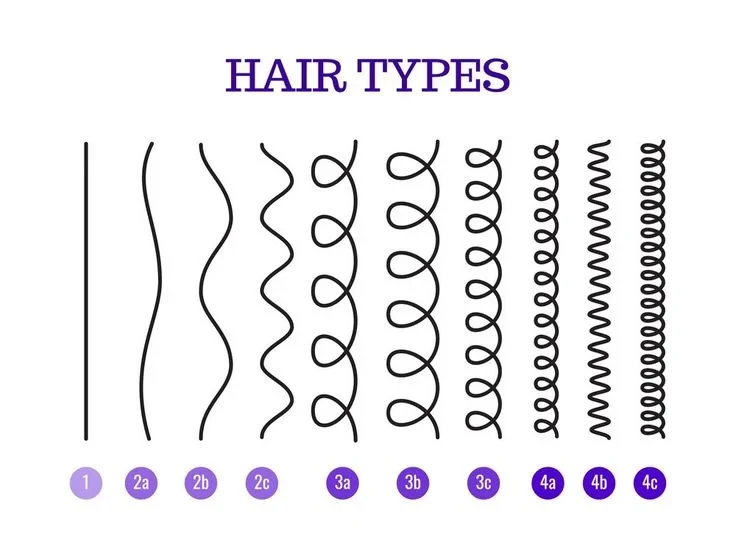
A hair types chart is a visual or descriptive system that groups hair according to its natural curl pattern from straight Type 1 to coily Type 4. Modern consumer charts usually divide each main group into A, B and C subtypes. These subdivisions describe increasingly pronounced waves, curls or coils within the broader category.The chart provides convenient language for discussing hair behavior and styling, but it does not describe every characteristic of an individual strand. Hair thickness, density and porosity are separate features. Scientific research also recognizes that simple four-category systems cannot capture the full biological diversity of human hair.
How Are Hair Types Classified?
Hair types are commonly classified into four main curl patterns: Type 1 straight, Type 2 wavy, Type 3 curly and Type 4 coily hair. This widely used classification focuses primarily on the shape that untreated hair naturally forms. Type 1 remains relatively straight, while Type 2 develops waves. Type 3 creates more complete curls, and Type 4 forms increasingly tight coils. Modern hair charts often subdivide these groups using the letters A, B and C. Scientific systems can use more objective measurements, including curve diameter, curl index and the number of waves along individual fibers.What Does a Hair Types Chart Look Like?
A typical hair types chart progresses from straight fibers to increasingly tight waves, curls and coils.- 1A: very straight with minimal visible bend
- 1B: straight with slightly more body
- 1C: straight with noticeable bends or texture
- 2A: loose and gentle waves
- 2B: more defined S-shaped waves
- 2C: strong waves approaching loose curls
- 3A: large, loose spiral curls
- 3B: smaller and springier curls
- 3C: tight, clearly defined curls
- 4A: small, visible coils
- 4B: tight bends with less uniform definition
- 4C: very tight coils with substantial shrinkage
What Is Type 1 Hair?
Type 1 hair is naturally straight hair that shows little or no repeating wave, curl or coil pattern when left untreated. Type 1A is usually described as very straight, while 1B may have greater body and volume.Type 1C can contain visible bends while still remaining predominantly straight. Straight fibers allow scalp oils to travel along the shaft relatively easily compared with highly curved hair. However, this does not mean every Type 1 head behaves identically. Fine and coarse straight hair can respond very differently to styling products, washing frequency and heat because strand diameter remains separate from curl classification.
What Is Type 2 Hair?
Type 2 hair is wavy hair that naturally forms visible bends or S-shaped patterns without developing complete curls throughout most of the length. Type 2A usually has loose waves that may appear almost straight near the roots. Type 2B develops stronger S-shaped movement, while 2C produces deeper waves that can resemble loose curls.Humidity can make wavy patterns more visible, while brushing may reduce definition and increase frizz. The distinction between 2C and 3A is not always clear because hair typing relies partly on visual interpretation. Different sections of the same scalp can also fall into neighboring categories.
What Is Type 3 Hair?
Type 3 hair is curly hair that forms recognizable loops or spirals rather than primarily S-shaped waves or tightly compressed coils. Type 3A generally produces larger spiral curls, while 3B has smaller and springier curls. Type 3C describes tight curls with a noticeably smaller circumference. Curly hair can experience dryness because natural oils do not move along curved fibers as easily as they move along straighter hair. It can also tangle when neighboring curls interact. Conditioning and careful detangling therefore become important for limiting unnecessary friction. The exact routine still depends on density, porosity and strand diameter rather than curl type alone.What Is Type 4 Hair?
Type 4 hair is tightly coiled hair characterized by small curls, bends or compact patterns that can produce considerable shrinkage when dry. Type 4A commonly displays small but recognizable coils. Type 4B generally has tighter bends with less consistently visible spiral definition. Type 4C is widely used to describe very compact coils with substantial shrinkage and limited visible definition. Recent research emphasizes that high-curl hair contains considerable variation that simplified typing systems cannot fully represent. Highly curled fibers can also be more vulnerable to dryness, tangling and mechanical breakage, making gentle handling especially important.What Do A, B and C Mean in Hair Types?
The letters A, B and C indicate variations within each major hair-type group, usually progressing from a looser pattern toward a stronger or tighter pattern. Within Type 2, this means moving from loose 2A waves toward pronounced 2C waves. Type 3 progresses from larger 3A curls toward tighter 3C spirals.Type 4 moves from recognizable 4A coils toward increasingly compact patterns commonly described as 4B and 4C. These letters should be treated as descriptive guides rather than precise biological boundaries. The difference between neighboring categories can be subjective, especially when one person naturally has several curl patterns.
How Can You Identify Your Hair Type?
You can identify your hair type by examining the natural pattern of clean hair after allowing it to dry without straightening, curling or heavy styling. Look at several sections rather than judging one strand. Hair that remains straight belongs broadly within Type 1. Repeating S-shaped waves indicate Type 2, while complete spiral curls suggest Type 3.Very tight coils or bends generally fall within Type 4. Identification becomes less reliable when heat damage, chemical straightening or heavy styling has altered the shaft. Because neighboring categories overlap, selecting the closest overall pattern is usually more useful than trying to classify every strand perfectly.
Can You Have More Than One Hair Type?
A person can naturally have more than one hair type because curl patterns frequently differ between the crown, temples, nape and other scalp regions. Someone may have 2C waves around the front and 3A curls elsewhere. Another person can combine 3C curls with 4A or 4B sections. This variation does not indicate damage or an incorrect classification. Broad typing systems simplify a complex biological trait into categories that are easier to communicate. Research measuring individual fibers also demonstrates substantial variation that simple visual groupings cannot capture completely. For practical hair care, observing how different sections behave can be more useful than forcing the entire head into one subtype.Is Hair Type the Same as Hair Thickness?
Hair type is not the same as hair thickness because curl pattern describes strand shape, while thickness describes the diameter of an individual hair fiber. A person with 4C hair can have fine individual strands, while someone with straight Type 1 hair can have coarse strands. Fine, medium and coarse hair can therefore occur within every curl category. Thickness affects how hair responds to weight, heat, chemical processing and styling products. Fine strands can become overloaded by heavy products, while coarse strands may respond differently to the same formula. A useful hair profile should identify curl pattern and strand diameter separately rather than combining them into one description.Does Porosity Affect Hair Type?
Porosity does not determine hair type because it describes how easily the hair shaft absorbs and releases moisture rather than its natural curl shape. Low-porosity hair generally resists water penetration, while more porous fibers absorb moisture more readily and can also lose it quickly. Straight, wavy, curly and coily hair can each have different levels of porosity.Chemical treatments, repeated heat and physical damage can also change how the cuticle behaves without changing the genetically determined pattern of new growth. This is why two people with the same 3B or 4A pattern can respond very differently to conditioners, leave-in products and styling routines.
Does Hair Density Affect Hair Type?
Hair density does not determine hair type because density describes how many hair fibers occupy the scalp, while hair type describes the shape of those fibers. Someone can have low-density 3C curls or extremely dense 2B waves. The visual result may make identical curl patterns look very different. High-density hair often appears fuller and may require sectioning during washing or detangling. Lower-density hair can become weighed down more easily by heavy styling products. Density should also be distinguished from strand thickness because a person can have many fine hairs or fewer coarse hairs. Curl pattern, density and diameter together provide a more useful description than any single category.Should Hair Type Be Checked Wet or Dry?
Hair type is generally easiest to assess after the hair has been washed and allowed to dry naturally without products that strongly alter its pattern. Wet hair can appear longer and looser because water adds weight and temporarily stretches curls. Highly coiled hair can show particularly dramatic differences between wet and dry length because of shrinkage. Heavy creams and gels can also exaggerate definition, making classification less representative of the untreated pattern. Looking at several clean, naturally dried sections provides a more practical assessment. However, examining wet hair can still help reveal hidden curl groups when frizz makes the dry pattern difficult to distinguish clearly.How Does Hair Type Affect Hair Care?
Hair type affects hair care mainly by influencing tangling, moisture distribution, shrinkage and the amount of friction created during washing and styling. Straighter hair may become visibly oily sooner because sebum travels more easily along the shaft.Curly and coily hair commonly needs greater attention to conditioning and gentle detangling because the fibers can be drier and more fragile. Tightly curled hair should generally be detangled while wet and conditioned rather than brushed aggressively when dry. Excessive heat and high-tension hairstyles can damage every hair type, although tightly curled fibers can be particularly vulnerable to mechanical breakage.
Is the Hair Types Chart Scientifically Accurate?
The hair types chart is useful for everyday communication, but it is not a complete scientific measurement of human hair structure. Research recognizes four broad consumer categories of straight, wavy, curly and coily hair, yet more objective systems can measure physical characteristics such as curve diameter and wave number. Recent studies show that broad visual categories do not fully capture biological variation between individual fibers.Modern reviews also caution against assuming curl pattern from ethnicity because considerable variation occurs within populations. The chart is therefore best used as a practical descriptive tool alongside strand thickness, density, porosity, damage history and individual hair behavior.