Why Afro Hair Follicles Curve Beneath the Skin
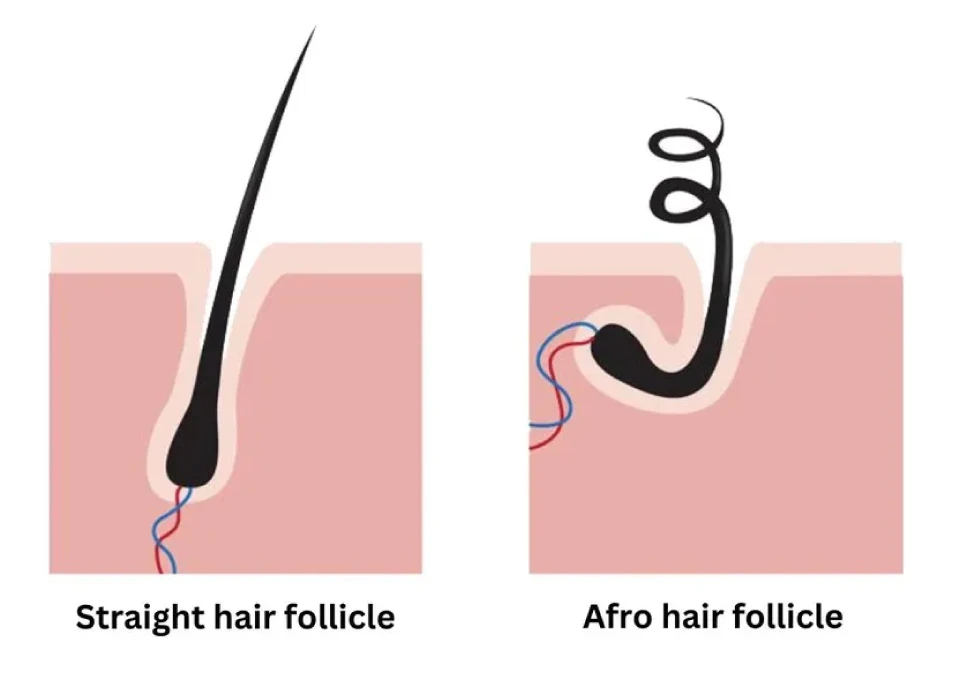
This guide explains why Afro-textured hair follicles often follow a curved path beneath the scalp, how that anatomy creates tightly curled hair, and why it matters clinically.
Why Do Afro Hair Follicles Curve Under the Skin?
Afro hair follicles often curve beneath the skin because the follicular canal develops with an asymmetric shape rather than following a perfectly straight path. This curved anatomy influences how the growing hair shaft forms before it ever reaches the scalp surface. The follicle can bend through the dermis while the emerging hair follows that same general direction. As the shaft develops, uneven cellular activity and keratin organization further reinforce the curl pattern. Several structural features contribute to this shape:- Curved follicular canals
- Asymmetric follicle geometry
- Uneven keratin formation
- Elliptical hair shafts
- Angled emergence from the scalp
- Variable curvature between neighboring follicles
Is the Follicle Shape Different in Afro-Textured Hair?
Afro-textured hair follicles often show a more curved or elliptical structure than follicles that produce straighter hair. The difference appears below the scalp as well as in the shape of the visible hair shaft. A straighter follicle tends to guide the developing hair along a more direct route toward the skin surface. A curved follicle changes that path before the shaft emerges. The follicle itself also tends to show greater asymmetry. That asymmetry affects how cells divide and how the shaft becomes organized during growth, which helps produce a tighter curl once the hair leaves the scalp.How Does Follicle Curvature Create Curly Hair?
Follicle curvature contributes to curly hair by shaping the developing shaft unevenly as it grows through the follicular canal. The hair begins acquiring its curvature before it becomes visible above the scalp. Cells on different sides of the follicle do not always grow or harden in exactly the same way. This uneven development creates mechanical differences across the shaft. As the hair extends outward, those differences become increasingly visible as bends, coils, or tight curls. The final curl pattern therefore reflects both the internal follicle shape and the structure of the shaft produced inside it.Why Is the Hair Shaft Often Elliptical Rather Than Round?
The hair shaft in tightly curled hair is often more elliptical because the follicle produces the strand with unequal dimensions across its width. This asymmetry makes the strand more likely to bend rather than grow in a straight line. A rounder shaft distributes structural forces more evenly around its circumference. An elliptical shaft creates unequal resistance along different axes, which supports curvature. The cross-sectional shape alone does not determine the entire curl pattern, but it contributes substantially. Follicle direction, internal protein organization, and shaft geometry combine to produce the final texture seen above the scalp.Does the Hair Bulb Influence the Curl Pattern?
The hair bulb contributes to curl formation because it contains the actively growing cells that produce the hair shaft. When growth within this region becomes asymmetric, the emerging strand can develop unevenly from its earliest stage. Different sides of the growing follicle can produce cells at slightly different rates or organize structural proteins differently.That imbalance encourages the shaft to bend as it lengthens. The result develops gradually through the follicular canal. A curved bulb and asymmetric growth environment therefore help explain why tightly coiled hair can maintain a consistent pattern from the scalp outward.
What Causes the Follicle to Grow at a Curved Angle?
A curved follicle develops through a combination of inherited follicular anatomy, asymmetric tissue organization, and the orientation of the follicular canal within the skin. Genetics strongly influences these structural characteristics. The curve is not created by styling, brushing, or external manipulation. It forms as part of the follicle itself and affects the direction in which the hair travels beneath the surface. Because the follicle can bend before reaching the skin, the visible exit angle may not reveal the complete underground path. This distinction becomes particularly important during procedures that involve extracting the entire follicular unit.Does Every Afro Hair Follicle Have the Same Shape?
Afro hair follicles do not all have the same shape because texture varies widely between individuals and even between different areas of one scalp. Some follicles curve sharply, while others follow a gentler arc. The visible hair may range from loose curls to tightly coiled patterns, and the underlying anatomy reflects that variation.Genetic diversity also means that ancestry alone cannot predict one exact follicular shape. Even within the same donor area, neighboring follicles can point in slightly different directions beneath the skin. This variability explains why careful assessment matters more than assuming that every Afro-textured follicle behaves identically.
How Deep Does an Afro Hair Follicle Curve Beneath the Skin?
An Afro hair follicle can begin curving within the dermis and continue along an angled path before reaching the deeper portion containing the bulb. The exact depth and shape vary between individual follicles. The important point is that the visible hair direction does not always continue as a straight underground line. A follicle may enter the scalp at one angle and curve further below the surface. This three-dimensional path matters during extraction because the full follicular unit must remain intact. Following only the visible shaft direction can increase the chance of cutting across the curved structure.Can You Predict Follicle Curvature From the Visible Curl?
The visible curl gives some information about follicular geometry, but it cannot reliably reveal the exact underground path of every follicle. Surface texture and subcutaneous curvature are related without being identical. A tightly curled shaft may come from a strongly curved follicle, yet neighboring follicles can still follow different directions beneath the skin. The external strand also bends further after emerging because of its own shape and internal structure. For this reason, visible curl pattern should guide expectations rather than serve as a precise map. The underground follicular course must still be treated as variable.Why Can Afro Hair Grow Almost Parallel to the Scalp?
Afro-textured hair can emerge at a relatively low angle because curved follicles often approach the skin surface obliquely rather than vertically. This direction allows the strand to lie closer to the scalp soon after emerging. The curl then changes its direction repeatedly as the shaft gains length. That creates volume while still allowing the root segment to remain close to the skin. A low exit angle has practical importance during transplantation and grooming. It affects how the hairline should be reconstructed and how instruments should approach follicles during donor extraction.Does Follicle Curvature Make Afro Hair More Fragile?
Follicle curvature does not automatically make the follicle weak, but tightly curved hair shafts can experience greater mechanical stress along repeated bends. Natural scalp oils also travel less easily along a highly coiled strand. That combination can leave the hair shaft relatively dry and more vulnerable to breakage during aggressive detangling, chemical processing, or heat styling. Breakage should not be confused with follicular hair loss. The follicle may remain completely healthy while the visible shaft snaps above the scalp. This distinction matters because shaft fragility and root-level hair loss require very different approaches.Why Are Ingrown Hairs More Common With Curved Follicles?
Curved follicles can increase the likelihood of ingrown hairs because a tightly curled strand may bend back toward the skin after shaving or very close cutting. The sharp cut end can then re-enter nearby skin. Several factors increase this tendency:- Tight curl geometry
- Very close shaving
- Low hair exit angles
- Skin friction
- Repeated razor passes
- Hair cut below the skin surface
- Local inflammation after re-entry
Does Follicle Curvature Affect FUE Hair Transplantation?
Follicle curvature can make FUE extraction more technically demanding because the follicular unit may bend beneath the scalp instead of following the visible hair shaft in a straight line. A straight punch path can therefore cross the follicle. This challenge becomes especially relevant with tightly coiled hair. The operator must account for the possibility that the underground portion changes direction after entering the dermis. Successful extraction depends on understanding both surface angle and deeper curvature. The goal is to free the follicular unit while minimizing transection, unnecessary tissue injury, and overharvesting of the donor area.Why Is Transection Risk Important in Afro Hair Extraction?
Transection risk matters because cutting through a curved follicle can damage the graft and reduce its value for transplantation. The challenge increases when the follicle bends away from the visible shaft direction beneath the skin. A graft may look intact at the surface while part of its deeper structure follows a different route. Advancing an extraction tool too deeply along a straight path can intersect that curve.Repeated transection also wastes donor resources. Since the donor supply is limited, preserving viable follicular units becomes especially important when planning large restorations.
How Can Curved Follicles Be Extracted More Safely?
Curved follicles can be extracted more safely when the extraction approach respects their variable direction and avoids assuming that every graft follows a straight underground path. Technique must adapt to anatomy rather than force anatomy into one pattern. Important considerations include:- Careful assessment of surface direction
- Conservative punch advancement
- Awareness of deeper curvature
- Appropriate punch size
- Controlled rotational movement
- Frequent inspection of extracted grafts
- Even distribution across the donor area
Does DHI Change the Challenge of Curved Follicles?
DHI does not remove the extraction challenge created by curved follicles because DHI mainly concerns implantation rather than the underground shape of the donor follicle. The graft still has to be removed safely first. When a procedure uses FUE-style extraction followed by DHI implantation, curved donor anatomy remains relevant during the harvesting stage.The implanter device only becomes involved after the graft has been extracted. DHI can provide controlled placement in the recipient area, but it does not straighten the follicle or change its original anatomy. Donor extraction remains the critical stage for avoiding transection.